Posts

Deleuzian Difference and Deleuzian Repetition (Or, Against the Concept)

I wrote this a couple of years ago now, but it still holds up as a primer on what Deleuze is up to with 'difference' and 'repetition' as a pair of terms (and not, ' Difference and Repetition ' the book). So we begin with a question: What is (the significance of) ‘difference’ and ‘repetition’ in Deleuze? Part I: Basics Before getting to grips with Deleuze’s understanding of ‘difference’ and ‘repetition’, the most important term to understand is the concept . As we’ll come to see, both difference and repetition are, in some ways, opposed to the idea of the concept. What is a concept? Very roughly, a concept is a ‘general’ idea that is ‘instantiated’ in particular instances of that idea. For instance(!), you have a concept 'horse', on the one hand, and then particular horses, horses which actually exist, on the other. The idea is that the concept always remains the same such that for the diversity of actually existing horses, there is always one and the sam...

Review Essay of Jonathan Lear's Radical Hope: Ethics in the Face of Cultural Devestation

Image
This is small review essay of Jonathan Lear's  Radical Hope . Published in 2006, it's book whose themes - cultural devastation and hope - only really seem to have grown in pertinence since its publication. I was introduced to this book only two years ago, in a talk given a professor who was enthusiastically giddy over it, and finally, after letting that charge of excitement stew in me since, I've managed to get around it. In fact it's the second book of Lear I've now read, after thoroughly enjoying his  Happiness, Death, and the Reminder of Life, a fantastic contemporary reckoning with the Freudian death drive as read though (and against) an Aristotelian lens. Bad news is that in comparison,  Radical Hope ...  has problems. As I hope you'll read below!     There’s a story that Jonathan Lear tells here about the young Crow medicine man, Wraps His Tail. It’s a story incidental to the book, one mobilised in the course of narrating the life of his preferred ...

Review of Alain Badiou's Logics of Worlds: Being and Event II

Image
Slowly making my way through Badiou's oeuvre, and no doubt at some point in the next few years I will have gotten around to his Immanance of Truths . But in the meantime, here are some thoughts on his second Big Book, the Logics of Worlds (2006). Cover of my copy of Alain Badiou's Logics of Worlds: Being and Event II Attributed to Plato by ancient astronomers, the question of how to ‘save the phenomena’ was, so it was said, among the most pressing of issues for the earliest star gazers. For, if according to the rationalist strictures of ancient cosmology, celestial motions were to be accounted for by the divine regularity of periodic movement, how was it that actual observation would reveal aberrant paths, retrogressions of planets and uneven solar passages? How could it be that the appearance of planetary motion not coincide with the being of their postulated reality?   On the one hand, then, Being: simple, regular, and sanctified. On the other, Appearance: messy, bodily, an...

Small review of Jonathan Lear's Happiness, Death, and the Remainder of Life

Image
The following is written in memory of Jonathan Lear, whose writings live on as a remainder of his own life, come to an end a week before this. This is a small book with themes writ large. At just under a 170 pages of main text, the title alone gives a good idea of what’s in store, although it’s worth taking a moment to pause and really sit with the grouping: happiness, death, and life (the remainder of). Is this not the range of philosophy itself? And I want to say: it is, and Lear covers it all, making good on the promise of what what it means to ask: what is it to live? And where, if anywhere, is the promise of happiness among this thing we call living? Taking as his loadstars the writings of Aristotle and Freud - the inaugural philosopher and the inaugural psychoanalyst - Lear explores how each, in their adventures to trace the shape of human life, stumbled upon a certain remainder that they never were quite able to square with their quest for principles, a reminder in whose excess ...

Deleuzian Immanence: A Primer

I wrote this some time ago as a kind of primer to Deleuze's understanding of immanence. I'm still pretty happy with it, although I'd add two things. First, I'd suggest reading this together with the pieces on univocity  and ' non-ontology ', both of which I wrote some time after this. Together, I think they form a nice triptych of Deleuze's philosophy as trying, fundamentally, to get at the same thing in a few different ways. An 'overthrowing' of ontology in favor of a thinking of 'life', the stakes of which, beyond mere labels, have to do with a primacy of ethics. Univocity in particular is that which 'cashes out' the promise of immanence: to think Being under the demand of immanence transforms it into a thinking of Life. Second, I wish I qualified a little better the 'comologizing of thought' I mention in Part II, which risks a strong pan-psychic reading of Deleuze. I think this ought to be avoided, but a proper eng...

Review of Oyèrónkẹ́ Oyěwùmí's The Invention of Women: Making African Sense of Western Gender Discourses

Image
Been a while since I've done one of these! So here's a bit of a review of  Oyèrónkẹ́ Oyěwùmí's  The Invention of Women: Making African Sense of Western Gender Discourses: If feminism at large has taught us anything, it has taught us to look for the woman: the woman in history, the woman in art, the woman in society. In each case where women have been erased, the work of feminism has laboured to put her back into the picture, picking her out from the depths of patriarchal overwriting, and returning her to the light where she belongs. But what if, in our zeal, we've begun to look for woman where she never existed? What if the woman - as we know her - has been an invention all along, an imposition even, not only from the West (onto the Rest), but on the West itself, and anything but a naturally given category from which analysis and action would flow?  That, at least, is the argument given here in this tremendous work of sociology, which, by running 'We...

Small review of Mahmood Mamdani's Define and Rule: Native as Political Identity

Image
I capped off 2024 by reading Mamdani's Neither Settler Nor Native , which was a fantastic romp, so I figured I'd get around to the little book that came before it, his 2012 Define and Rule . Here's what I thought of it. Define and Rule is something like the skeleton key to Mahmood Mamdani's more recent and elaborate Neither Settler Nor Native . As the smaller, more focused work however, it packs an undeniably larger punch. Its objective is straightforward: to get at the specificity of how imperial 'indirect' rule worked (particularly under the British), as distinct from the earlier 'direct' rule of Roman empire. The answer too, is relatively straightforward. If the Romans ruled over subjects whose identities were already largely defined and given, the British (and Dutch) took this one step further and intervened in the very shaping of the identities of those they colonized. Such was the distinction between the Roman 'divide and rule', a...

Review of Nandita Sharma's Home Rule: National Sovereignty and the Separation of Natives and Migrants.

Image
Here's my review of Nandita Sharma's Home Rule: National Sovereignty and the Separation of Natives and Migrants. This was really a perfect follow-up to the Mamdani that I just read . Where Mamdani tracks the distinction between 'settler' and 'native', Sharma extends the analysis to the 'migrant' and the 'native'. A real nice paring. Interesting that they were both published in the same year! What I like about this book the most was the way in which it captured an entire arc of history that began with slavery and, frankly, still hasn't ended. This kind of contextualizing of the present is incredibly useful in orienting things, and I'm super grateful that I read this book, actually. A good way to start the year. Anyway, here's the review proper: If politics everywhere is now marked by ascendant 'nativisms' and outpourings of aggression directed at migrants and 'foreigners', Nandita Sharma's Home Rule has got to b...

Review of Mahmood Mamdani's Neither Settler nor Native: The Making and Unmaking of Permanent Minorities

Image
My last blog post for the year! A review of Mahmood Mamdani's Neither Settler Nor Native: the Making and Unmaking of Permanent Minorities. This is one of those books that I learnt so much from, but still found it wanting. Plan is to read alot more Mamdani after this! This is a fantastic book. World-spanning, epoch-capturing, but let down, ever so slightly, by a certain political naïvety. But first, the good stuff. More than anything, what Mamdani has shown here is the specificity of our post-colonial present: that the colony and its afterlives are, in fact, a present , and not just a long forgotten past, swamped over by the march of a homogenising globalisation. Which is to say: even as we live in an age characterised by the “end of colonialism”, what has been reproduced everywhere are the dynamics of colonialism in conditions other than directly colonial ones. Despite having wrested self-determination for themselves, many ex-colonies have nonetheless been left with the...

Deleuze on Univocity: An Explainer

Image
Deleuzian Terms: Univocity This is probably the longest (and most technical) exposition of a Deleuzian concept that I've written on. I've been tinkering at it for an incredibly long time now, writing, forgetting, and returning to it a few times over literal months. Really, alot of this is a (non-comprehensive) exposition of chapter 1 of Difference and Repetition , with insights from alot of disparate secondary reading thrown in to help. While I don't think univocity is 'the most important' concept in D&R (is there one?), I do think that it is maybe the one which illuminates the stakes of what is going on that book the best. Hence why both the opening chapter and closing paragraphs frame everything between precisely in terms of the quest for the univocal. Hopefully this is helpful in explaining why! Part I: Univocity, Equivocity, Analogy Q: What is univocity for Deleuze? A: Univocity answers the question of how to think ab...

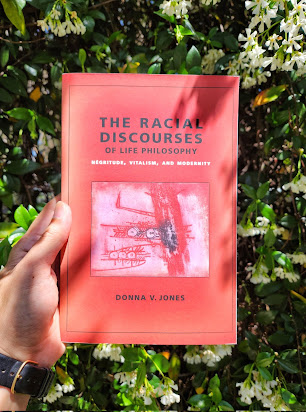
Review of Donna Jones' The Racial Discourses of Life Philosophy: Negritude, Vitalism, and Modernity

Image
Here's my review Donna Jones' The Racial Discourses of Life Philosophy: N é gritude, Vitalism, and Modernity. As a quickie: I adored this book, it's easily among my favorites that I've read this year. This is one of those books that, although about a very specific topic, branches and sprawls out about itself in such a way as to detail an entire culture of thought, one which still persists today, and whose relevance has anything but waned. The topic is this: the work of Henri Bergson and his relation, or, better to say, his uptake among the writers of the Négritude movement. But if this is the narrow prism though which the book's light is reflected, that light itself blankets the entire noon of modernity stretching from Ezra Pound to Marcel Proust, Gertrude Stein and D. H. Lawrence - so many stars among others in the constellation of modernity through which not just Bergson, but Bergson ism , would wind its way through. A meditation on life and race, and the ways in ...